Showing posts with label Shaelynn. Show all posts

Monday, February 5, 2018

4 EdTech Ways to Differentiate in a Student-Centered Classroom

Co-Written with my friend and business partner Shaelynn Farnsworth

In all the work that Shaelynn and I do with teachers across the US and beyond we see educators creating amazing learning environments for students. From the use of 1:1 technology to enabling students to learn authentically, these really are incredible times to teach and learn.

However, among all the flash and pageantry there is struggle. Educators are looking for ways to personalize the learning environment for every student while trying to find ways to differentiate; it can become paralyzing. On the one hand, they have the traditional methods of accessing content and assessing what students have learned. On the other, they have rooms full of technology but aren’t yet taking full advantage of that that technology can do for each student.

Carol Ann Tomlinson said it best:

“At its most basic level, differentiation consists of the efforts of teachers to respond to variance among learners in the classroom. Whenever a teacher reaches out to an individual or small group to vary his or her teaching in order to create the best learning experience possible, that teacher is differentiating instruction.”

Differentiation isn’t just something that some students need or some teachers have to do, differentiation is responsive teaching and a part of every classroom. Each student comes to the classroom with a variety of past learning experiences, prior knowledge and individual learning needs and styles. Whether it is to help a student who struggles to understand basic content, a student who just needs a little push to go deeper or a student who far exceeds our expectations and needs the opportunity to go further, differentiation should be and must be a part of every classroom.

Differentiation comes in many varieties. Teachers can differentiate in four classroom components based on student readiness, interest, or learning profile:
  • Assessment – Understanding what students know and still need to learn
  • Content – What the student needs to learn or how the student will access the information
  • Process – Activities in which the student engages in order to make sense of or master the content
  • Products – culminating projects that ask the student to rehearse, apply, and extend what he or she has learned in a unit

(There is also some evidence that differentiation of the classroom environment, the design of the learning space, furniture used, etc, can also help with differentiation. If you want to learn more learning space design check out the work of Bob Dillion.)

When we layer technology into these 4 components, the process of differentiation becomes less daunting and more accessible to each student. Here are 4 Edtech Ways To Differentiate In The Student-Centered Classroom:

Assessment-Sometimes seen as a four-letter word in the world of education, assessment, if done correctly, can provide a mountain of valuable information that can help teachers determine where students are in their learning and where the teacher needs to go in their teaching. Particularly, formative assessment is the driver of differentiation of assessment. Formative assessment acts as a GPS, providing valuable information both the teacher and the learner. It provides timely feedback to inform instruction and make adjustment. When assessment is used to adjust instruction it crosses over into the “formative assessment” realm. This crossover helps teachers and students to see it, not as a test, but more as a process.

Technology isn’t necessary to do any type of formative assessment. However, if we layer in the effective use of technology into formative assessment we can not only reach students where they are in their understanding but look at trends over time and respond accordingly in our teaching.

Some Of Our Favorites:
Poll Everywhere
Quizziz
Nearpod
Flipgrid
Recap App

Content-When many teachers consider differentiation they look to content as the way to do it for most students, and rightly so. Content is the foundation of learning and skills are applied. Therefore, if we can provide a way for students to access that content at their level, we can better meet their learning needs. Each student is (and should be) held to high standards. But we know not every student is on the same path for their learning. Through the differentiation of content we can level the playing field for each student.

Technology has made it much easier and frankly more possible to differentiate content in new and exciting ways. In some cases, students can be given the same content, however it is tailored to their individual needs either through raising or lowering the reading level, providing more visualizations or still meeting standards but providing content that is interesting and exciting for students.

Some Of Our Favorites:
Newsela
CK12 Flexbooks
MyOn
The Kid Should See This

Process-Differentiation of the processes by which students learn is another traditional way that teachers provide different learning paths for students. For many students the instructional practices are outdated and do not meet their needs. If we want to create an environment where each student can find success no matter their learning profile than we have to look beyond traditional pedagogy and meet students where they are at and how they want to consume information.

Technology makes the differentiation of process easier. Accessibility tools built into modern devices make it easier for us all to use those devices more effectively and efficiently. And many of those tools can benefit all students. In addition, the idea of gamifying learning is gaining steam to provide an environment that is familiar to students, but also is fun, challenging and rich with varied learning opportunities.

Some Of Our Favorites:
Breakout EDU
Duolingo
CommonLit
Read & Write For Google Chrome

Product-Ultimately, students need to demonstrate their holistic understanding of the content. Traditionally that is done through a summative project. However, this method is flawed when we produce a list of items that students must include, the specific font to use, the number of cited sources, etc. That isn’t a project, that is a recipe. And recipes don’t belong in the classroom. Students need freedom of choice in how they demonstrate their understanding. That doesn’t mean it’s a free-for-all. We can provide creativity, choice and freedom within boundaries.

Technology is truly transformational and students should be able to demonstrate understanding through a variety of transformational ways. This differentiation of product can look different for each student, however, at the heart are the same learning goals. Through the effective use of technology students can do incredible things while still demonstrating what they know and how they know what they know.

Some Of Our Favorites
BookCreator
Instagram and Snapchat
SeeSaw
Canva

Want to learn more? You can grab a copy of our resources from our FETC 2018 Presentation or inquire about a workshop on EdTech Ways to Differentiate in the Classroom by contacting Steven, http://www.web20classroom.org/contact

Wednesday, March 22, 2017

4 Pieces Of The Connected Educator Puzzle

Steven Anderson and Shaelynn Farnsworth lay out what Connected Educators do and how it’s a always a work in progress.

Educators today can no longer just walk into the classroom, shut their door and teach. In every facet of our practice there are other educators doing amazing things that we can all learn from. Through the creation of our Personal Learning Network we find smart folks we can learn, share and grow with. The whole purpose of creating a PLN and becoming a Connected Educator is learning to network but also networking to learn. We are all smarter when we connect to each other.

The 4 Pieces Of The Connected Educator Puzzle

Connect-The first step in becoming a Connected Educator is to, well connect! There are so many great educators doing great things and they are sharing them on a near constant basis. In order to take advantage of all that learning we have to go to where they are. Traditionally, Twitter has been the entry point for many looking to grow their PLN. And rightly so. Twitter is easy to use, tweets are short in length, and by utilizing hashtags, has something for everyone. No matter your content area, grade you teach or topic you are interested in there are educators on Twitter to connect with and learn from.

Twitter works for many but may not work for all. Being a connected educator doesn’t mean limiting yourself to one place or another. We have to seek out diverse voices in multiple places.

  • The Classroom 2.0 Community is one place to start. It is one of the oldest social networks for educators. 
  • Another place would be the various Google Communities that are full of educators sharing and growing. 
  • Edweb has many communities on a variety of topics like leadership, technology, literacy and more. 
  • Facebook, too, is full of educator groups and pages to connect with others. 

It really doesn’t matter what place you go to to find smart folks to connect with. The point is to go to those places and find the voices that matter to you and your learning.

Consume- Once you are connected, then you can begin to see the large volume of resources, ideas, blog posts and more that are shared and exchanged nearly every hour of every day. There is power is lurking and consuming the stuff others are sharing. If we are lurking we are learning. And it’s a powerful second step to becoming a connected educator.

The places to consume wonderful educational content are vast and endless.

  • Twitter again is where many start. Hashtags contain so many wonderful links and ideas you can spend hours there. #Edchat, #edtech, #makered, and #pbl are just a very small part of the much larger educational hashtag community. But remember, we need diversity in places to learn. 
  • Blogs can be a simple and easy way to consume. And the Teach100 list has many to choose from. 
  • Also, all the communities we looked at above have resources and great content shared all the time. 
  • Need to learn on the go? The list of educational podcasts is growing day by day. 

Just like it doesn’t really matter where you go to connect, there is no singular best place to consume for learning. Both of us mix it up daily. Steven will read tweets and then listen to a podcast. Shaelynn will check out what’s happening in Google Communities and then read some blogs. Every day is different for us both. Learning and sharing happens everywhere and we have to go to where it is, everyday.

Converse- Consuming information is just part of the overall evolution of a Connected Educator. The next piece of the Connected Educator puzzle is to join the conversations. In Steven’s book The Relevant Educator he explains that Connected Educators discuss, debate and exchange ideas. There are many ideas in education that deserve more conversation, further inquiry and collegial debate. And it’s in those conversations, especially with those that have different views from our own, where we can push our thinking and extend our learning.

All of the places we’ve looked at to connect and consume have places for conversations. On many blogs the comments section provide a place to push back or extend the thinking. All of the communities have ongoing conversations that you can join or start your own to get others talking. Twitter chats are a quick and easy way to jump into conversations on all sorts of topics. Many of the hashtags that are great for consuming content also have synchronous chats that take place at scheduled times. There are non-traditional places too like Voxer where you can connect, consume and converse.

Contribute- The last piece of the puzzle for becoming a Connected Educator is contributing. All of us is an expert in something. Even if we don’t think we have anything to add we will find something in our learning that others can benefit from. Sharing is how we all learn from each other, finetune our craft and invite others into our classroom. Start a blog. Send some tweets. Start your own hashtag chat. Visit an Edcamp. Record your own podcast. Whatever you do, share your learning and your brilliance with the world.

Being a connected educator isn’t a specific recipe you can follow. You don’t master one step and move to the next. Both of us will tell you that, while we’ve been Connected Educator for many years we both still consider ourselves a work in progress. You never really “arrive” as a Connected Educator. It’s an ongoing process that you change and perfect over time.

Connect With Us!

Steven W. Anderson
Website: http://www.web20classroom.org
Blog: http://blog.web20classroom.org
Twitter: @web20classroom

Shaelynn Farnsworth
Website and Blog: http://shaelynnfarnsworth.com
Twitter: @shfarnsworth

Monday, February 13, 2017

10 Characteristics Of An Authentic-Based Learning Classroom

Along with my good friend and literacy expert Shaelynn Farnsworth, we examine what authentic learning means and what these classrooms truly look like. 

Reimagining education is frequently sparked by advancement in technology. From the introduction of the No. 2 pencil to the streaming of video in to support learning and teaching, technology is typically the driver to change. Ubiquitous technology in learning environments has sparked a current redesign of the “classroom” and asks us, as educators, to once again create authentic classrooms for the students of today.

Before Steven left his position as a Director of Instructional Technology, his district was undergoing this shift (albeit a bit late, but they were headed in the right direction). They were going to allow students to bring their own device to the classroom to use in the course of their learning. But through a pilot program they discovered that the focus of their professional development around BYOD needed to not be on technology. Rather, they needed to focus their efforts on pedagogy and the change in instruction needed when students have access to all known knowledge at their fingertips.

When we combine the ubiquitous use of technology and the near constant access to all known knowledge the classroom environment must change. The traditional “stand and deliver” instruction model negates the fact that teachers are no longer the source for all information. Authentic-Based Learning Environments emphasize the need for a shift in curriculum to one of Project and Problem Based Learning where students are immersed in learning that has them identify and solve real-world problems. Students are at the center of Authentic-Based Classrooms and take ownership of the information they need to solve these problems and determine their own methods of demonstrating understanding.

What are the Characteristics of an Authentic-Based Learning Classroom?

  1. Real-World Learning and Tasks-In these classrooms learning and tasks are centered around real-world problems. Students are investigating issues that face their school or their community or themselves as individuals.
  2. Content Is Student Selected-In Authentic-Based Classrooms, student choice in content (full or in-part) heightens relevance and engagement. Students begin to understand their own ways of learning and what methods best meet their individual needs. 
  3. Interdisciplinary Learning-In these classrooms there will be a variety of content sources that naturally lend themselves to interdisciplinary study. Students may be working on math and music or science and art, all at the same time, which only serves to show them the natural connections between what we learn instead of the traditional silos many students experience. 
  4. Open-Ended Inquiry-In these classrooms students may all be working on the same learning but there are going to be varied approaches to the solutions. And through their discovery students may see that there are many paths they can take and they should be allowed to follow them. 
  5. Frequent Reflection-Learning happens throughout the process and not necessarily at the end of a unit. Portfolios and process journals, for example, provide a reflective space for students capture their learning. In Authentic-Based Classrooms regular reflection is a must. Students take time  to review, plan, and set new goals in their learning, while teacher reflection serves as a type of formative assessment which informs instruction.
  6. The Knowledge Of Others Is Valued-In these classrooms there is great value in the knowledge not just from traditional sources but also from subject matter experts and non-traditional sources like blogs and social media. Students can reach out through the use of their growing Personal Learning Network (PLN)  to collaborate and learn from others. Access to technology connects students with experts from across the globe. Global connections not only provide access to primary sources, but serve to teach our students about diversity, tolerance and empathy. Through connections, social media, and digital publications, students see how information is constantly changing and how they must adapt. 
  7. Creation is Valued Over Consumption-In these classrooms the emphasis isn’t on the acquisition of knowledge. The value is in what students create with the knowledge they acquire. Similarly to student choice in content, choice is creation and demonstration of understanding amplifies student voice and provides students multiple modes in which to elaborately communicate their learning. 
  8. Assessment Focuses on Mastery of Concepts-In these classrooms not only is the learning authentic but the demonstration of student understanding is as well. Simple regurgitation of information or traditional letter grades do not provide any type of meaningful feedback. Mastery of standards and evaluation of learning against teacher-student created rubrics are what is seen. Students’ understanding looks at more than knowledge gained and aims to have students do something more meaningful with that knowledge.
  9. Authentic Audience-In Authentic-Based Classrooms there is a shift in audience from the traditional lone teacher to one that is determined by the student or task. Student learning regularly reaches outside the classroom. Therefore the audience does too by having students sharing with the community and often times on a more global scale. 
  10. Flexible and Evolving Learning Spaces-In these classrooms the physical set up and the types of tools and technology students have access to is constantly changing and adapting to meet the needs of the learners. Furniture can be moved so that students can collaborate more easily. Classroom environment may also spill over into the community or to a virtual space. Student choice in device or other resources is possible, allowing them choose the best tool for the job. Educators understand that though it may look chaotic the classroom space is an extension of how students choose to learn. 

The Authentic-Based Learning Classroom is one of fluidity. There is constant change and adaptation to new methods of content discovery, different ways of demonstrating understanding and of course, new problems to solve. Technology enhances the ability of the student to do more but remember, technology isn’t the focus here. The focus is on the authenticity of the tasks, the authenticity of the learning, what new knowledge students can create and what problems they can solve.

Download the Post Image

Tuesday, June 14, 2016

10 Student-Centered Ways To Use Blab In The Classroom with @shfarnsworth

Screenshot 2016-06-13 at 11.26.41 PM.png
This post is the result of a collaboration between myself and my good friend Shaelynn Farnsworth

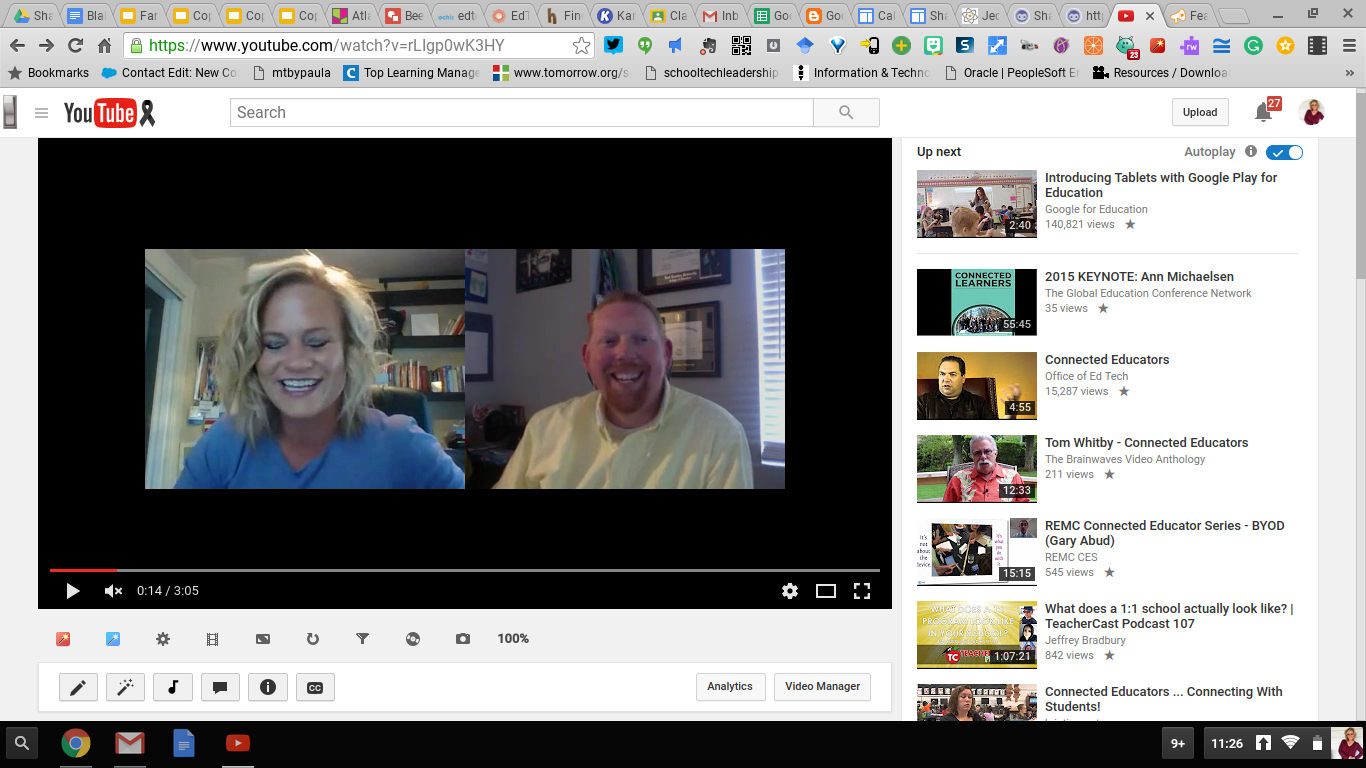
I always enjoy learning about new tools and the place they possibly could have in the classroom. When my friend Shaelynn reached out to me to record a video with her for a project on Connected Educators I jumped at the chance because she was going to introduce me to a new platform. 

Blab is a live-broadcasting app that streams video to a “Public” or “Unlisted” stream (host’s choice). With 4 “Open-Seats” available in each Blab, topic-driven conversations are shared with a live audience. Interaction also occurs via text through live audience participation. While anyone can call-in (or ask) for an “Open-Seat”,  only the host can approve who receives the spot. Moderating participants came in useful when we were Blabbing; people from Australia to Korea all wanted to join in the live conversation.

Blab also allows users to record all or a portion of their live stream. Sharing is easy; the video can be embedded, tweeted, posted on Facebook, and even shared to the user's YouTube channel. Finally, like other social media platforms, “following” and “followers”, help you be part of the conversations that matter most to you!


Shaelynn and I agreed, Blab was fun, easy to use, and versatile which makes it great for classroom use. After our Connected Educators conversation, we starting chatting about the ways this could be used in the classroom. Here are the Top 10 Ways Students could use Blab in the classroom:

10 Ways Students Can Use Blab in the Classroom - by Steven Anderson and Shaelynn Farnsworth
  • Interviewing Experts and Primary Sources - Students are no longer limited by location to the information they have access to. Technology provides opportunity and means for learning to expand beyond the walls of the classroom. Blab provides an easy way for students to connect with and interview experts, gaining new information from primary sources. 
  • Live Demonstrations of Science Experiments - In science class we certainly want students to get hands on when it comes to experimenting. But there are cases where, for safety or other reasons, keeping them at a distance is best. Through Blab the teacher can be conducting the experiment remotely and have the rest of the class join, share and comment through a Blab. The best part? Experiments no longer have to be tied to the classroom? So if there are investigations where more expertise is needed the teacher can go to that location (like a local university with more resources) while students view from afar. 
  • Student Presentations To Authentic Audiences - Many times the work students do lives between themselves and their teacher. The hours of work they spend creating and crafting is sometimes seen by their classmates but rarely anyone else. With Blab, students have a live, authentic audience to present their findings or project to. Using the chat feature they could solicit feedback or opportunities for growth. An since Blab supports up to 4 video feeds a lively discussion could also take place, face-to-face, with reviewers from across the world. 
  • School or Community News Broadcast/Journalism - Live streaming of school events, sharing of news in the district or community, all provide students the option of reading, writing, and speaking in authentic and engaging ways. Pairing Blab with student journalism provides a multimedia avenue in which students hone life skills. The ability to embed the final video or upload to YouTube give students a way to share their work long after the Blab is over.  
  • Students Practicing Reading/Literacy Skills - Students, especially younger students need opportunities to read and practice their growing literacy skills. Blabs could be set up between an Elementary classroom and a Middle School or High School class where younger students practice reading to older students. The reverse could also happen too. As students are developing those critical literacy skills they need to hear them modeled. So the older students could read to the younger students as well. All of this recorded for feedback and reflection later. 
  • One on One Conferencing/Peer Feedback - With any type of feedback, be it from reviewing a paper or project or looking at overall learning objectives and goals, having a peer review process in place in the classroom can help students think more intrinsically about their own thinking. Using Blab, students can peer review each other and record that feedback for analysis or use later. And the peer doesn’t have to be a classmate. Since Blab is global, peers can be anyone, anywhere in the world. 
  • Cross Curricular Projects/Group Work - Group work is at the heart of a collaborative classroom. However, what do students do when the bell rings for the day? They still have work to do together but are going off to their different homes. Blab can bridge the gap between group members allow them to chat, share links and talk through their work. For the teacher, sessions could be recorded to review the thinking and dynamics of the groups later. 
  • Creating a Culture of Awesome - Video provides a powerful glimpse into the lives of our students. Using Blab as a way to spotlight students, or other educators in the district shines light on all of the good happening in the school. By allowing students to create the video, ownership in message which transfers to a positive climate and culture of a school heightens student voice and models a positive way social media can be used to make a an impact.
  • Field Trip Recaps - Video reflection through Blab can help kids sort through experiences and anchor their learning. After field trips, speakers, and other academic experiences; students can follow-up with a video response. Done with a small group of peers, Blab is a perfect app in which students can share their learning. Download the Blab app onto your phone, and students are now mobile videographers, sharing their learning along the way.   
  • To Create Shared screen or tutorials - Have students create tutorials using Blab. Whether demonstrating Minecraft in the classroom, or how to write a Shakespearean Sonnet, when students are doing the teaching, students are also the ones doing the learning.  
Have an idea to help make Blab better? Share here, I Blab, the uservoice forum to share your thoughts!